
The Society’s Autumn Conference will take place online on 7 November 2026.
You can find the Conference Plan and the Abstracts below.
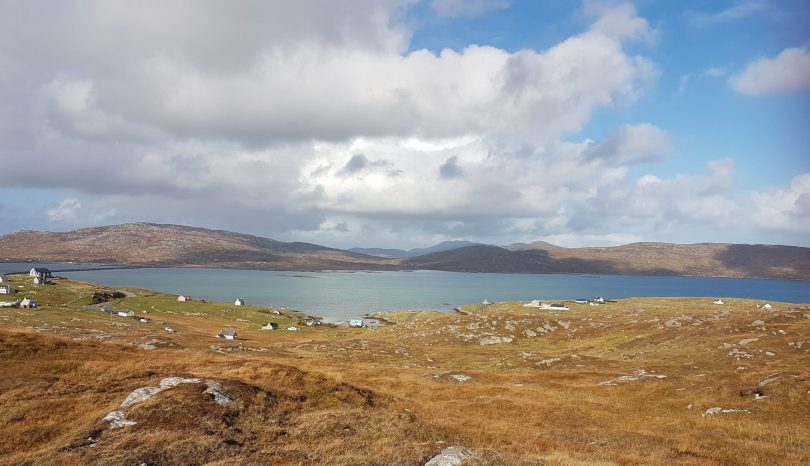
Image: Glac na Còmhraig, Eriskay. Photo: Lorne Gill, Scottish Natural Heritage, 2019.
REGISTRATION
CONFERENCE PLAN
| 10:00 – 10:05 | Welcome Morag Redford, University of the Highlands and Islands |
| 10:05 – 10:35 | ‘Place-names of Carrickfergus’ Phil Ó hEochaidh, Author of ‘Place-Names of Carrickfergus & Broadisland’ (2024) |
| 10:35 – 11:05 | Three etiological legends for the Eriskay placename ‘Glaic na Còmhraig’ Liam Crouse, University of the Highlands and Islands (SMO) |
| 11:05 – 11:30 | Break |
| 11:30 – 12:00 | Diverging Landscapes. Interpreting differences between fieldwork data and place-name data Rebecca Madlener, University of the Highlands and Islands (SMO) |
| 12:00 – 12:30 | A Handbook for (Top)onomastic Researchers Sarah Künzler, Luzerner Namenbuch Projek |
| 12:30 – 13:30 | Lunch |
| 13:30 – 14:00 | The meaning of carden revisited: Pictish royal hunting grounds Fiona Campbell-Howes, University of Glasgow |
| 14:00 – 14:30 | Hidden Boundaries: Ordnance Survey Boundary Remark Books as a Source for Place-Name Research Scott Lloyd, Comisiwn Brenhinol Henebion Cymru |
| 14:30 – 14:45 | Break |
| 14:45 – 15:15 | Named Places and Wilderness in Tóruigheacht Dhiarmada agus Ghráinne: An Ecocritical Look Larissa Toal, University of Glasgow |
| 15:15 – 15:45 | Reflections of Gaelic heritage in the street names of Girvan Alina Brust, University of Glasgow |
| 15:45 – 16:00 | Summing Up & Fin |
ABSTRACTS
Three etiological legends for the Eriskay placename ‘Glaic na Còmhraig’
Liam Crouse, University of the Highlands and Islands (SMO)
Three etiological legends tied to the Eriskay placename ‘Glaic na Còmhraig’ (ScG, ‘The Glade of the Battle’) will be explored in this paper. Narrated through the twentieth century within the same closeknit community, the legends provide divergent claims as to the battle that produced the name: a battle for peat harvesting rights (probable nineteenth century setting), a clan battle, and a Norse battle. The contexts for each legend will be scrutinised to uncover features of folk etymology, including a possible migratory legend. Beyond an attempt to determine historicity, the case study serves to improve our understanding of variation and variety within oral traditions associated with placenames.
***
Diverging Landscapes. Interpreting differences between fieldwork data and place-name data
Rebecca Madlener, University of the Highlands and Islands (SMO)
Linguistic studies of landscape vocabulary benefit from interdisciplinary approaches that combine different types of data. Previous landscape semantic studies have pointed out the value of including place-name evidence in linguistic studies. My ongoing PhD research on Scottish Gaelic landscape vocabulary, therefore, combines fieldwork with native Gaelic speakers with a study of place-names and the physical reality of the features that different terms are applied to in order to gain a more thorough understanding of the target terms’ semantics than fieldwork alone would provide.
The fieldwork consists of multiple interviews with each informant, including open conversations about the local area and its landscape, questions about appropriate terms for features shown in photographs and requests for participants to explain differences between terms. The place-name research makes use of a list of place-names that was compiled from published and unpublished sources (e.g. maps, archival material from place-name surveys, names provided by this study’s informants). Detailed information about each place-name containing the target terms was gathered (e.g. size, location, shape, geology, specific element) and used to differentiate elements.
Small differences between the fieldwork data and the place-name data were expected (e.g. some terms being restricted to use in place-names). However, the differences between the informants’ understanding of the target terms’ semantics and the place-name evidence exceeded those expectations. For some terms, individual informants were sure of their semantics but the explanations differed across informants. Some of those explanations matched the place-name evidence, others disagreed with it. This raises questions about how these data divergences should be interpreted, such as: Are data divergences reflecting differences between the local lexicon and the onomasticon (i.e. vocabulary used in place-names)? Are they indicative of (ongoing) semantic shifts? What do they tell us about the Gaelic landscape vocabulary and past and present Gaelic speakers’ perception of the landscape?
***
A Handbook for (Top)onomastic Researchers
Sarah Künzler, Luzerner Namenbuch Projek
PD Dr. Phil. Barbara Aehnlich and Dr. Sarah Künzler have started work on a handbook for (top)onomastic researchers. The two-volume handbook will provide a practical guide for those conducting (top)onomastic research. Questions of selecting informants, preparing for and conducting interviews and evaluating data are addressed in volume one, while volume two will focus on data storage and accessibility. A special focus lies on interpersonal interview skills and on creating productive interview situations. The handbook aims to broaden the researchers’ skills set while acknowledging the particular challenges (top)onomastic research presents.
***
The meaning of carden revisited: Pictish royal hunting grounds
Fiona Campbell-Howes, University of Glasgow
The place-name element carden has long been hailed as a vestige of the Pictish language, appearing in names ranging from Kincardine on the Dornoch Firth to Carden Den in Fife. Its original meaning, however, remainsunclear, with its poorly-attested Welsh cognate cardden suggesting ‘thicket’, ‘enclosure’ or ‘fort’, according to GPC.
I will take a different approach to interpreting this element, using historical, sculptural, landscape and toponymic evidence from within Scotland to propose that carden places were hunting grounds reserved for the use of Pictish elites. More speculatively, I will propose that the element survived the language shift from Pictish to Gaelic in eastern Scotland due to its utility as a legal term, rather than as a purely topographical one.
***
Hidden Boundaries: Ordnance Survey Boundary Remark Books as a Source for Place-Name Research
Scott Lloyd, Comisiwn Brenhinol Henebion Cymru
The Ordnance Survey’s county series 25-inch maps are a cornerstone of historical and place-name research, providing the earliest consistent large-scale mapping of much of Britain. Less widely appreciated is the parallel programme of boundary surveying undertaken by the Ordnance Survey. Working with local meresmen and other informants, surveyors documented administrative boundaries in remarkable detail, recording their findings in the Boundary Remark Books. Over 30,000 of these volumes survive.
Research in Wales has shown that these records preserve evidence for historic boundaries, landscape features and place-names that is often unavailable from either maps or other documentary sources. The books capture local knowledge at a critical moment in the nineteenth century, recording features and names that have since been altered or lost. This paper examines the research potential of the Boundary Remark Books through Welsh case studies and presents an initial assessment of the Scottish material.
***
Named Places and Wilderness in Tóruigheacht Dhiarmada agus Ghráinne: An Ecocritical Look
Larissa Toal, University of Glasgow
This paper focuses on the narrative functions of placenames within the Early Modern Irish text Tóruigheacht Dhiarmada agus Ghráinne (TDG), or The Pursuit of Diarmaid and Gráinne. Although TDG is a text rich in placenames, there has to date been no sustained investigation into how those placenames function within the text. This paper begins to fill that gap, drawing on insights from ecocritical theory, placename studies, and literary studies on the intersection of landscape and text. It argues that in TDG named places exist within, rather than in opposition to, the natural world, and that placement allows them to serve as markers of narratively important turning points within the text. It further explores the implications that has for the development of localised versions of the tale or episodes from it across Ireland and Scotland.
***
Reflections of Gaelic heritage in the street names of Girvan
Alina Brust, University of Glasgow
While there are a number of projects investigating Gaelic place names in south-west Scotland, they have focused on names of settlements and the natural landscape, rather than street names. Conversely, research on street names as markers of a city’s socio-cultural composition has often neglected broader aspects of language. This paper seeks to combine these issues by investigating the street names in Girvan, a town with a rich Gaelic history but little Gaelic culture surviving into the present, to examine if traces of the area’s Gaelic heritage have been preserved in the town’s street names and in what ways. For this, a selection of street names with likely Gaelic origins is discussed in detail before considering the wider context of Gaelic in the streetscape, especially the influence of farm names. A brief account of street names in Inverness is given to provide a contrast with a place that has a more lasting Gaelic heritage. This finds that general street name distribution is similar in both places, as Gaelic is mainly represented incidentally by transposing names from the wider local landscapes onto street names. However, analysis of street names in respect to the Gaelic language still has merit, which is discussed in relation to the element balloch ‘pass, road’ preserved in modern Girvan street names.